
Posted:
Thu Jul 11, 2013 6:22 pmby BendyFlyer
Seeing that ADRIAN did such a great job on the repaint of the JBK Hythe into a RNZAF Sunderland Q for Queenie, I thought I would add to the process and compliment his fine work with a remake of the JBK Hythe into a proper Sunderland MK V as operated by 5 Squadron RNZAF by changing all the stuff that needed to fixed and which could be modified or changed for it to be a proper Sunderland.
I have repainted the cockpit to the standard Sunderland black (Still shading and texture issues to make it not seem so bland). I have not been able to change the lever balls to red/green due to the way textures are mapped by the model files. I am adding a lot more instruments and switches to the VC cockpit so as to get it as close as I can to the real life Sunderlands. Both jobs are going well. I have modified the config and AIR files to reflect the correct data and specifications for a Mark V Sunderland. The engine data and prop data has been changed to reflect the proper engines, P&W R 1830s, not Bristol Pegasus engines. Flight testing so far indicates to me the changes and mods make the model behave as I would expect a Sunderland to and she handles well with no issues. Tthe main benefit so far seems to give a sense of weight and size and she now sits properly in the water as well. Yep and you have to get her on the step before you get airborne. I am also trying out a number of sound packages but a freeware DC-4 sound package sounds to be pretty close to the mark as well ( I am not sure how noisy the Sunderlands were in the cockpit but given the amount of glass and the close proximity of the engines I think it probably was quite noisy at power and in flight. Some of the additional instrumentation/light indicators and switches is proving tricky but not impossible and will take some time. I am still hunting around for a more authentic radio/navaid set to replace the FSX DC-3 installed in the model.
It is my intention to make it available to members of this Sim Site only in the first instant. A lot of stuff to do yet but progressing well. I will keep folks here updated and post screenshots when I can.
Posted:
Thu Jul 11, 2013 6:36 pmby Ian Warren
Pleased you have dug your heels in and furthered your , tweaking and builds modifying with what you have got , you are very limited without the source file of JBK , i'd be very much looking forward to it .
Posted:
Thu Jul 11, 2013 7:52 pmby deeknow
Fabulous stuff Bendy, nice effort, looking forward to the results, and some flying around the Pacific

Posted:
Thu Jul 11, 2013 9:07 pmby Splitpin

all the above comments repeated by myself .... yet another clever bugger in the hood .
Posted:
Thu Jul 11, 2013 9:43 pmby AdrianPetford
Well done. Looking forward to this. It'll be great to have a decent Sunderland.
Ade
Posted:
Wed Jul 17, 2013 12:52 pmby BendyFlyer
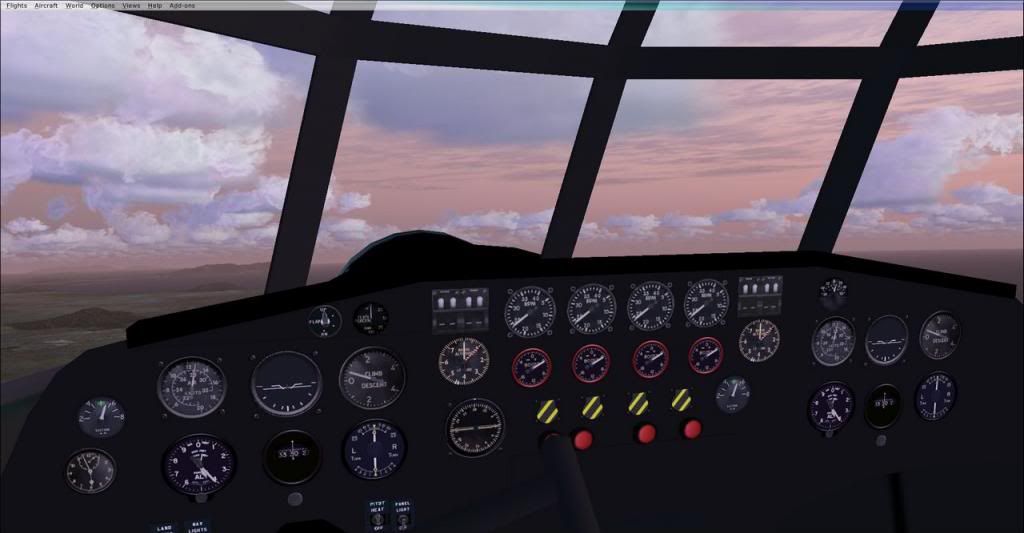
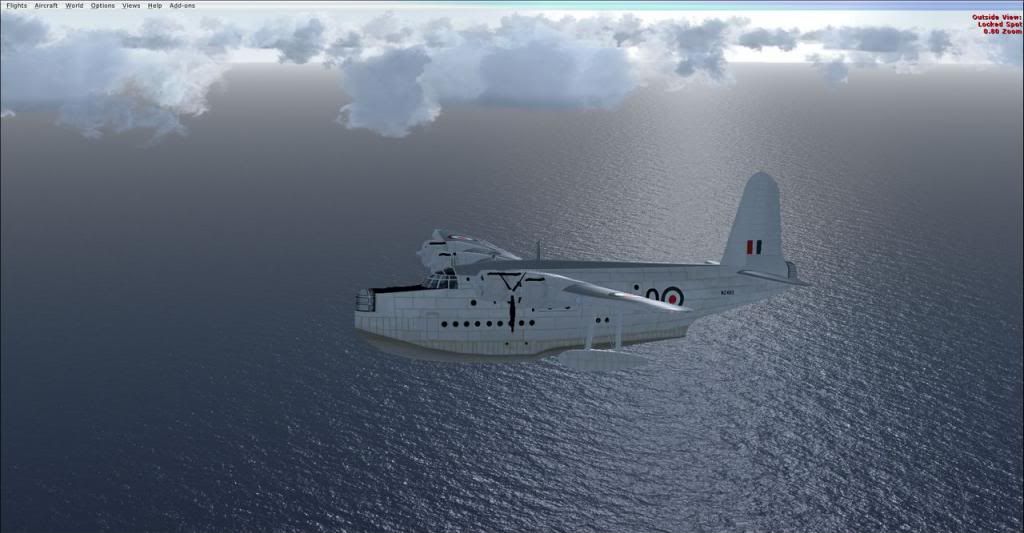
Ok time for an update. Still a WIP but progressing well so far. I am attaching two pictures. The first screenshot is of the cockpit the second screenshot is of the Sunderland with one engine feathered. All the cockpit instrumentation works bar the fire extinguisher buttons (still working on that) and the cockpit is modelled as closely as I can on the Sunderland at MOTAT in Auckland. I still need a really clear close up which I have not got to identify the instruments below the feathering controls in the centre panel. I am pretty sure they are military equipment dials and switches but as to what I have no idea SO if anyone out there can enlighten me I would love to know. As you are aware this is 1950'sw gear so will probably not be able to added functionally but a bitmap pic may be possible. I have added a new sound package and changed the lighting to use the Shockwave light addon.
There have been a lot of changes to the aircraft cfg to bring into line with the dimensions and specifications of the real Sunderland MKV and the end result so far is pretty good. I will have to provide pilot notes as there are a number of quirks to takeoffs and landings that you need to get used as the model now performs like a big heavy flying boat. One of these is speeds, control effectiveness and getting it on the step for takeoff. Feathering and restart check went well and she lumbers along at about 125 kts with one engine feathered at full load.
Still about a month to go at the moment and AB of this forum is assisting with some paint/textures tweaks and will be my Beta Tester. How and where to upload due to file sizes is an issue but thinking cap on that one as well.
More updates as things progress. But going really well and a credit to the inherent soundness of the original JBK Hythe/Sunderland design and build.
Posted:
Wed Jul 17, 2013 8:31 pmby Splitpin
Looking great .... well done , and with AB onboard as well

Posted:
Thu Jul 18, 2013 11:27 amby Ian Warren
Brilliant Bendy

, now that looks very much like the Sunderland in the photos i have here .
BendyFlyer wrote:Still about a month to go at the moment and AB of this forum is assisting with some paint/textures tweaks and will be my Beta Tester. How and where to upload due to file sizes is an issue but thinking cap on that one as well.
I simply would upload to flightsim.com with all the details and authors involved .. quick and easy
Posted:
Thu Jul 18, 2013 3:10 pmby BendyFlyer
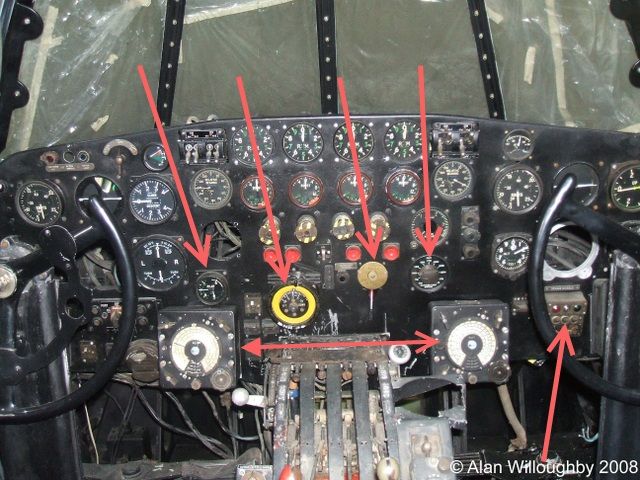
Ian and others, I only have a digital image from the web of the cockpit but it is too pixelated at blow up levels to read anything clearly. Does anybody have any idea what the two switches or cocks below the feathering buttons are and the dial to the right of them. The one with the yellow circle around it looks like a metal switch of some sort and the other looks like it might be an alternate static source lever/####. The gauge further to the right has me stumped, but I would hazard a guess that it has too do with weaponry (depth charges/bombs) as it is missing in all civilianised Sunderlands/Hythes that I have cockpit pictures of. The bottom two boxes with the large white round dials look like they might be the very old 1940's era radio tuners for the ADF or Range finders perhaps, not sure. There was a look of duplication of instrumentation in the cockpit which is understandable given the Sunderland actually was not designed with duplicate electrical/hydraulic systems like modern aircraft and a lot of the kit was pretty unreliable. Hence the prominent fire extinguisher buttons as the Sunderland was prone to overheating the engines, engine failures and fires as a result, mostly I think from them being operated very very lean on patrol to get the maximum amount of air time or endurance you could out of the available fuel
Any help from somebody in NZ on what these instruments or dials are would be appreciated. A phone call to MOTAT perhaps?
Posted:
Thu Jul 18, 2013 5:59 pmby Ian Warren
A thought , maybe you could post a screen showing the photo and hi-light the unknown gauge/butterfly switch ... the one to the very right in most likely a simple clock , but again maybe able to determine or good guess what it is .
One mentioned to me was with the Sunderland on when they where scrapped and in 1965 come the call "oh well we don't need these anymore" was all the fight manuals data , the MOTAT Sunderland cockpit the last i saw was stripped , ideal for texture but most every thing was pulled out and gone .
Posted:
Fri Jul 19, 2013 11:06 pmby BendyFlyer
Good Idea Ian
Here is a photo with the relevant instrument gauges arrowed to point to the relevant ones I cannot identify if anyone can help please PM me.
Posted:
Sat Jul 20, 2013 12:01 amby Ian Warren
Great Bendy ... horizontal arrow , they are radio/nav finders .. i have close up hi res photo's of them,
Posted:
Sat Jul 20, 2013 9:33 amby scaber
Somehow I missed the post about this project the first time but am really excited to see this coming along. It's looking good and I'm pleased to see your comments about the realism.
Posted:
Sat Jul 20, 2013 9:56 amby scaber
I'm guessing that you've already seen this resource:
http://www.seawings.co.uk/manualpage.htmhttp://www.seawings.co.uk/sundmanpage.htm - need to see the key in the lower images
I don't think these are like the one you are working on but maybe there could be some help there
Posted:
Sat Jul 20, 2013 10:04 amby Ian Warren
Great link Greg , i might have to get my grubby little fingers on the these
Posted:
Sat Jul 20, 2013 10:42 pmby BendyFlyer
Thanks Ian. Thought they were very old style rotating dial tuner for radio/nav gear. Hmmm have not seen anything on the www for flight sim that comes close to those! Real 1950's gear that was. The very right hand dial/switch is without a doubt military gear, it was akso in the MK III Sunderlands as well but alas my cockpit diagram list of illustrations is cut off right at the very number that the dial has. I wonder if it was an arming switch/calibrating dial for dropping exploding stuff. The very left hand one is a pressure gauge of some sort.
Trouble with these old aeroplanes is that they generally put stuff where ever blogs thought it was a good idea when they retrofitted them and the hurry they were in when they did it which is why English aeroplanes and American ones as well of this era, always had a dogs breakfast of a cockpit layout and very non ergonomic, they also seemed to work on the basis the less you could touch of fiddle with the better but then again they had lots of hands and mouths to do all the other stuff like look after engines, navigation and communications.
A flying boat also made life simple, no gear to go up or down, no brakes etc. The Sunderland was cable and wire flight controls with hydraulic servo boosters on the primary flight controls only. The flaps were electric and the autopilot a weird mixture of hydraulics and electrics hence the spaghetti plumbing maze on the left hand side etc. That was about it, simplicity itself.
Well might continue work on the FE position in the meantime, the GPS will have to do for a navigator.
Scaber, yes have those references, thanks anyway. They are the ones that are cut off right at the very number pointing to the other gauges/switches, bugger. Anybody know any old Sunderland mechanics who might be able to help?
Posted:
Sun Jul 21, 2013 11:05 amby NormNZ
Yes the units are remote control units for the Marconi 7092A ADF receivers - there was also one in the Navigators and Signallers position. What you are seeing is the printed dial scale, selected frequency is indicated by a rotating wire pointer against the scale.
The 7092A was part of a series of radio equipment designed by Marconi (UK) for the de Havilland Comet and was pretty modern at the time - it replaced the huge 1154 transmitter/1155 receiver that was originally installed in the Sunderland and many other British aircraft - if you want to see an 1154/1155 have a look in the beautifully restored Anson that we are lucky to have in New Zealand.
Included in the Marconi range was the AD97 and AD107 transmitters and the AD94 and AD108 receivers and as well as being installed in the Sunderland they were in RNZAF Devons and Doves, Bristol Freighters and I think the Hastings. VHF communication was via a TR1936 transceiver.
Posted:
Sun Jul 21, 2013 10:32 pmby BendyFlyer
NormNZ - thanks for that info. I have managed to find a radio/ gauge for the panel very similar which is good! I remember seeing a lot of this type of stuff in old aeroplanes but none quite like this Marconi set up you would want a nice and steady hand and aircraft to get them tuned I bet. Cheers
Posted:
Sun Jul 21, 2013 10:38 pmby Ian Warren
Bendy , Not that you can place a Marconi receiver into the VC in do have close up and hi res photos , one from a WWII Anson and the Bristol as well , be nice to get the source files and do a complete re-build .
Posted:
Mon Jul 22, 2013 11:52 amby NormNZ
Hi
Re your post #11 - just as a matter of interest where did the pic come from. I have spoken to a couple of other Sunderland Sigs and mentioned the panel to them.
CU
Norm


