Charl wrote:These tales inspire adulation and movies, but then there are those who assume Capt. Sullenberger simply did his job, and at best Did Nothing Wrong.
CP, what would be your take on the specific action points that made the escapade Great?
This “doomsday scenario” is something that pilots never train for. Double engine failures yes, but they are nearly always conducted at altitude and mainly in the cruise. The variables involved at low level are so vast that the training value would be very limited. Options would vary dependent on altitude.
The one thing that would be useful is to follow the pilot mantra “Aviate, Navigate, communicate”. They are in order of importance.
In Sully’s case the first thing to deal with would be the initial startle factor…the noise, the vibration, a “million” ECAM messages and warning lights all flashings distracting his attention. Some warnings and cautions are inhibited below certain altitudes to assist with this, but there would still be many. All of this and a rapidly decreasing airspeed. Any of these could lead to “tunnelled vision”…..a fixation on something that catches the initial attention. This leads to a rapid breakdown in situational awareness. Even when things become clearer, in that there is a recognition that both engines have failed, there may not be time to run the respective checklists. Even trying to determine if there is a total or partial failure will take time and divide attention. You have to be prepared to “go off script”.
Aviate.
This he did well. He put the aircraft into a stable glide. He then had to make massive shortcuts to the usual non- normal procedures. Pure primal instincts with back to basic “stick and rudder” operation and a forced landing that is essentially no different from a initial flight school training with the obvious exceptions of things happening faster, and requiring more real estate to land on. Some things take care of themselves, such as the APU auto starting, Eng auto relight (which I think they had) and the RAT deploying to assist. He did his best to achieve the best glide angle to “make time” and determine a course of action.
Navigate
He had a great sense of geographical position. I do not know what methodology he used to determine what airfields were within reach, but he nailed it. The Hudson would have been the early fall back position, whilst he determined which of the other airfield options could possibly be used. He was also acutely aware that he had very little time to decide.
Communicate
This is the most vexing of the 3 parts to the mantra. Time spent communicating with ATC, crew and passengers means less time to process other very important things. You also still have to Aviate and navigate. Firstly ATC has no idea what’s wrong. This takes time to communicate. ATC now have to deal with their own startle factor and try and understand the situation and determine how best to assist (as well as control current aircraft on frequency that could be affected). They also try to extract information such as your proposed actions, POB and fuel onboard. Nice to know but it takes time. They already know the last 2.
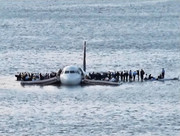
He quickly determined that the options suggested would not work and that he committed to the Hudson. He knew in his mind that a failure to land on an airfield would be disastrous. On water there is always a chance. Apart from the overhead bridges there is length available. This allowed him the remaining time to configure the aircraft for a ditching.
He was criticised for not landing back at LaGuardia airport, but simulator trials proved it would only work on the odd occasion, if executed immediately and that the sim pilots (Flight instructors) already knew what was coming beforehand. Teterboro was never going to work.
At the end of the day no one was killed and 152 passengers returned home.
He did a Stella job.




 to all the above replies..... 15 years ago!